As ICNZ lead partner, EMEC knows that shared learning is central to how we support the energy transition. By learning from innovation in real‑world settings, we help reduce the cost, risk and time involved in integrating low‑carbon technologies into energy systems.
Understanding the factors that enable technical solutions to work, including the social, geographical and regulatory contexts they sit within, is just as important as demonstrating them. Islands provide fertile ground for learning in this respect, often revealing wider energy system challenges at an early stage.
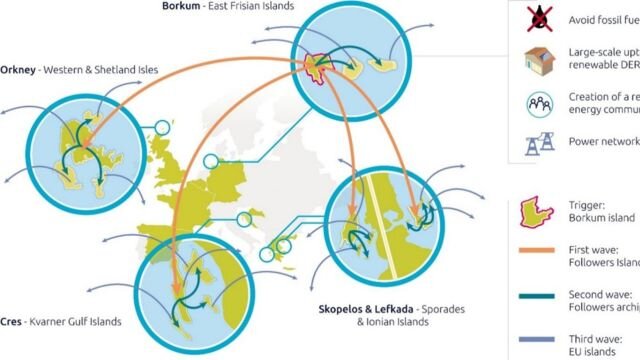
The EU funded ISLANDER project explored this by examining how smart‑grid solutions demonstrated on the island of Borkum in Germany might be replicated across other European islands. As a project partner, EMEC delivered detailed replication plans for Orkney, Shetland and the Outer Hebrides, assessing the feasibility of the ISLANDER concept and whether it could be adapted to their unique energy contexts.
In this blog, Islands Centre for Net Zero Programme Manager, Kristina Burke, reflects on ISLANDER, EMEC’s role the project, and why this learning matters going forward.
ISLANDER focused on demonstrating how smart energy management systems could support the decarbonisation of island energy systems by aggregating and optimising distributed energy resources and storage. This included technologies such as digital energy management platforms and grid‑stabilising solutions, to battery and hydrogen storage, EV smart charging, and district heating concepts.
These technologies were deployed and demonstrated on the island of Borkum in Germany, showing what is technically possible. Alongside this, the project worked with “follower islands” across Europe, including Orkney, to explore whether similar approaches could work in very different island contexts.
EMEC’s replication reports for Orkney, Shetland and the Outer Hebrides combined energy system mapping with analysis of grid, regulatory and market constraints, highlighting the gap between technical possibility and real‑world delivery.
Learning across island contexts: key findings
Through EMEC’s replication work for Orkney, Shetland and the Outer Hebrides, it became clear that replication is not a simple ‘copy and paste’ exercise. Instead, it requires careful translation to local conditions, taking account of regulation, infrastructure, geography, existing energy systems and community needs. Looking closely across these island groups highlighted how different those conditions can be, even where islands are facing similar challenges.
System and regulatory constraints
A consistent finding across all three island groups was that local electricity grids are constrained, with generators being controlled by Active Network Management. New technologies can be regarded as generation assets by the network operator which means that technologies such as batteries and EVs, that should help balance the grid, can actually be blocked by grid rules. Dispersed, distribution level solutions only work if the grid and regulatory regime accommodate them.
Energy system innovation is as much about working with network operators and regulation as it is about hardware.
Heat, housing and social context
When looking at decarbonising energy systems, electricity is only part of the picture, with heat accounting for a significant share of energy use and emissions. Older housing stock and high levels of fuel poverty are shared challenges across all three island groups. None of the islands are connected to the mains gas network, and the reports identified district heating is only viable in specific locations. This reinforced that solutions focused solely on electricity risk missing where the greatest emissions reductions and social impacts can be achieved.
All of this work shows that there is no single island energy solution. Early stage feasibilities and system mapping can save time and cost while helping communities, funders and policy makers understand how to adapt ideas to local conditions, avoid dead ends and inform better decision making.
Different starting points and transition pathways
While common challenges exist, the three island groups are starting from different positions.
Orkney was an early adopter of renewable energy generation, which has brought both opportunities and challenges. High levels of local generation, combined with increased demand from the electrification of heat and transport through technologies such as heat pumps and electric vehicles, are placing growing pressure on existing grid infrastructure. As a result, further decarbonisation in Orkney increasingly depends on expanding grid capacity and aligning regulatory frameworks with the realities of a highly renewable system.
Shetland is beginning to see its energy system reshaped by large‑scale wind generation plans and new transmission links to the mainland. These developments will introduce significant volumes of generation connected to the national system, far exceeding local demand. While this supports wider decarbonisation goals, it may also influence how grid capacity is allocated locally, with implications for the viability of smaller‑scale and community‑focused energy solutions such as those explored through ISLANDER.
The Outer Hebrides are at an earlier stage of their decarbonisation journey, where establishing baseline data and strengthening grid resilience are key priorities, particularly as the islands are expected to play a growing role as landing points for future offshore wind and transmission infrastructure.
This highlights how similar technologies can play very different roles depending on where and how they are introduced.
Alongside this analysis, EMEC also brought together participants from Orkney, Shetland and the Outer Hebrides in a technical workshop to reflect on the replication work. These conversations echoed many of the challenges emerging from the analysis. Participants spoke about ongoing regulatory and grid access constraints, concerns around fuel poverty and curtailment, and the importance of community‑owned generation. There was also strong interest in behavioural incentives, more localised energy pricing, and the need for continued advocacy for regulatory change.
From replication to realistic pathways
The replication studies highlighted the importance of sequencing, understanding what’s realistic now, what comes next, and what needs to change first for an energy solution to work in practice. Replication isn’t just about asking whether something could work in a place, but what needs to happen before it can. Across all three island groups, similar ideas emerged, but they landed at very different points in the transition, shaped by regulatory barriers, social starting points and existing system conditions.
Taking this learning into the Islands Centre for Net Zero
Seeing this across different island groups reinforced the importance of starting with communities themselves. That thinking carries directly into the work of the Islands Centre for Net Zero, which is focused on developing carbon‑reducing solutions from the ground up, shaped by communities rather than imposed from the top down.
EMEC supports the transition to a low carbon energy future through research, demonstration and consultancy work. The replication plans provide valuable baseline data and serve as practical foundations for future projects and policy engagement which will be taken forward by ICNZ. The reports can be read in full here:
Replication of project results - Orkney
Replication of project results - Shetland and Outer Hebrides
To enquire about how EMEC can support with replication studies, get in touch with: [email protected]