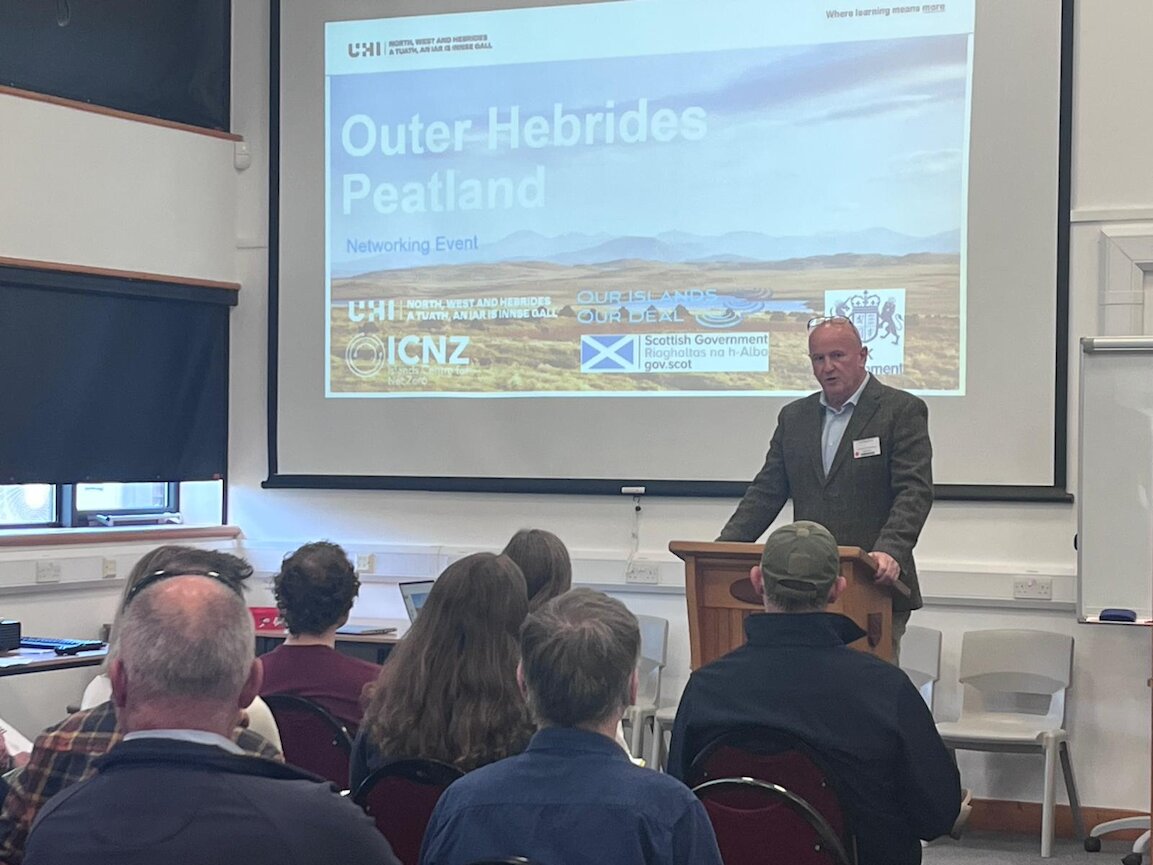
A recent networking event, organised by ICNZ and UHI North, West and Hebrides, brought together landowners, community groups, researchers, conservation organisations and public bodies to explore just that.
A key message emerged: peatlands are more than ecological systems. They are cultural landscapes, shaped by relationships between people, crofting, Gaelic culture, land ownership and the environment.
Discussions highlighted opportunities for:
- More island-based peatland training
- Greater engagement with schools and young people
- Stronger exchange between local and scientific knowledge
- Better peatland mapping and monitoring
- Research shaped by island needs
- Continued collaboration and knowledge sharing
The event also sparked discussion around establishing a collaborative peatland-focused group for the Outer Hebrides.
Joan D’Arcy, Research and Development Coordinator for UHI North, West and Hebrides, funded through the Islands Centre for Net Zero, said:
“Restoring peatlands is a priority for the Islands Centre for Net Zero. Pristine peatlands act as carbon sinks, while damaged or drained peatlands release carbon and are one of the leading sources of greenhouse gas emissions in the Outer Hebrides.
“The key message from the day was that peatlands in the Outer Hebrides are shaped by people, culture and heritage. They are vital habitats and ecosystems, and only by understanding these connections can we work together to preserve and restore them for future generations.
“Events like this also demonstrate the important role UHI North, West and Hebrides can play in bringing together communities, industry and researchers to support sustainable environmental change.”
The takeaway? There’s no one-size-fits-all approach to peatland restoration. Success means understanding the connections between peat, people, culture and land, and developing solutions that reflect the unique needs of the islands.