Heriot-Watt University is the research project partner of ICNZ, responsible for running Transition Engineering Labs which carry out locally relevant research to help solve problems where solutions are not yet known.
What is Transition Engineering?
Transition Engineering is a branch of engineering that looks at how our engineered systems — like transport and energy — connect with the economy and society. The goal is to redesign these systems so they use less energy and fewer resources, while also improving life for people and the planet.
Transition engineers help to achieve real-world transformative impact by adapting engineering principles and involving the active participation of different groups (local authorities, businesses, community groups, citizens etc).
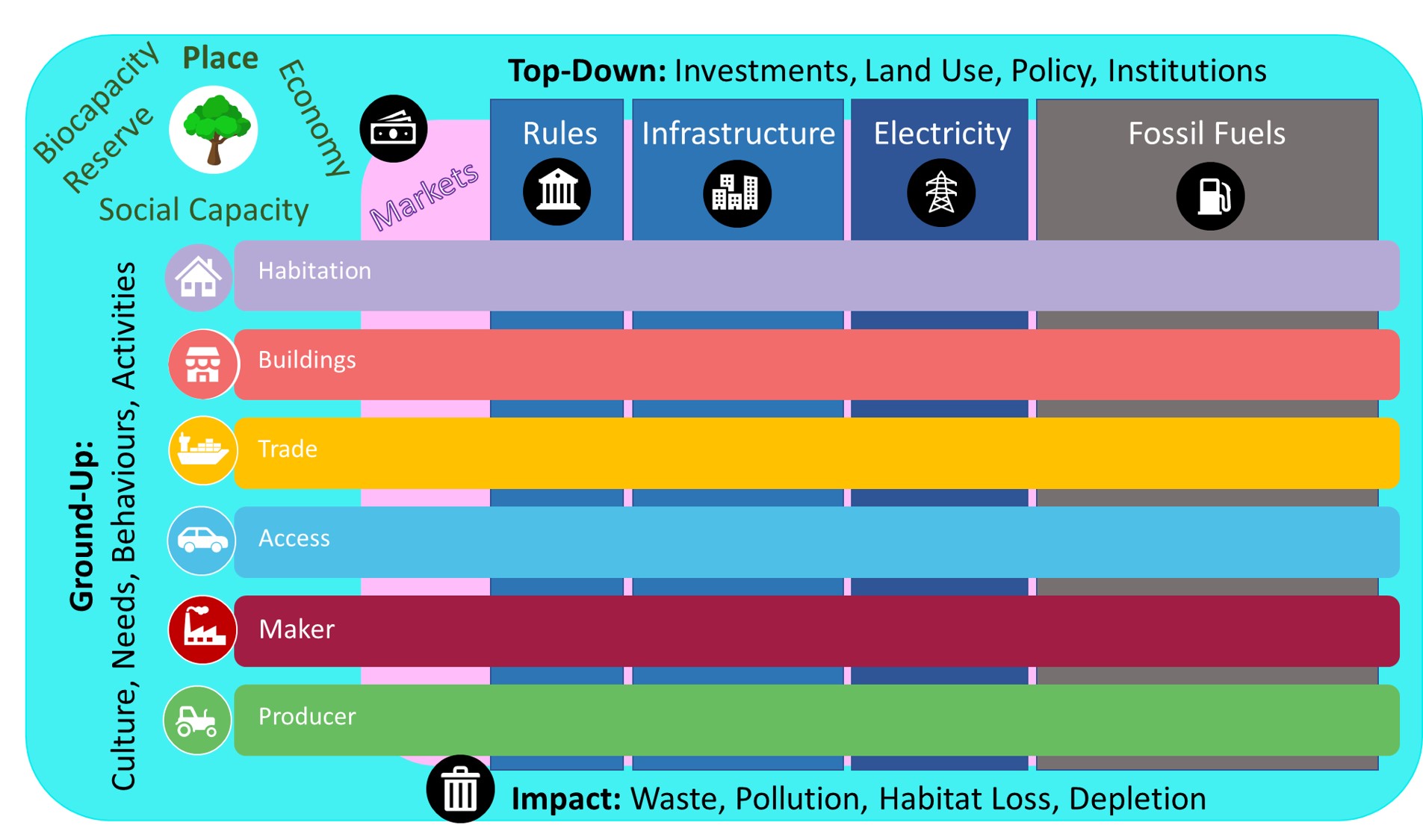
We use an ecosystem model (below) to understand how different parts of our systems are connected. This helps us tackle complex challenges, that we refer to as wicked problems, and come up with smart, practical responses.
What is a wicked problem?
Wicked problems are complex challenges with no easy solutions. They exist within a web of interconnected elements: engineered systems, economic activities, social systems, environmental factors, and communities (or stakeholders). Each element influences the others, highlighting the complexity and the need for a whole-systems thinking approach to truly understand and address wicked problems.
How do we work?
We bring together community and experts from different fields to help people collaborate in tackling the wicked problems of unsustainability. We offer transdisciplinary expertise, and creative whole-systems thinking is our strong suit.
Our research leads to fresh concepts — what we call shift projects — that can be developed further into real-world applications. These ideas may focus on areas such as policy, regulation, business models, education, and both digital and physical infrastructure.
Nearly all the concepts stemming from our research require innovation – not just in technology, but also in new perspectives, novel understandings, creativity, and strategic ingenuity.
If you are interested in working with us or simply having a chat you can contact us via our Expressions of Interest form.
We also teach a Transition Engineering course as part of the Master of Science in Renewable and Sustainable Energy Transition at Heriot-Watt University, available both locally and online.
Explore our work:
Academic papers by: Florian Ahrens, Jack Boulton and Paolo Cherubini
Find us online: Facebook, Global Association of Transition Engineering (GATE) and LinkedIn