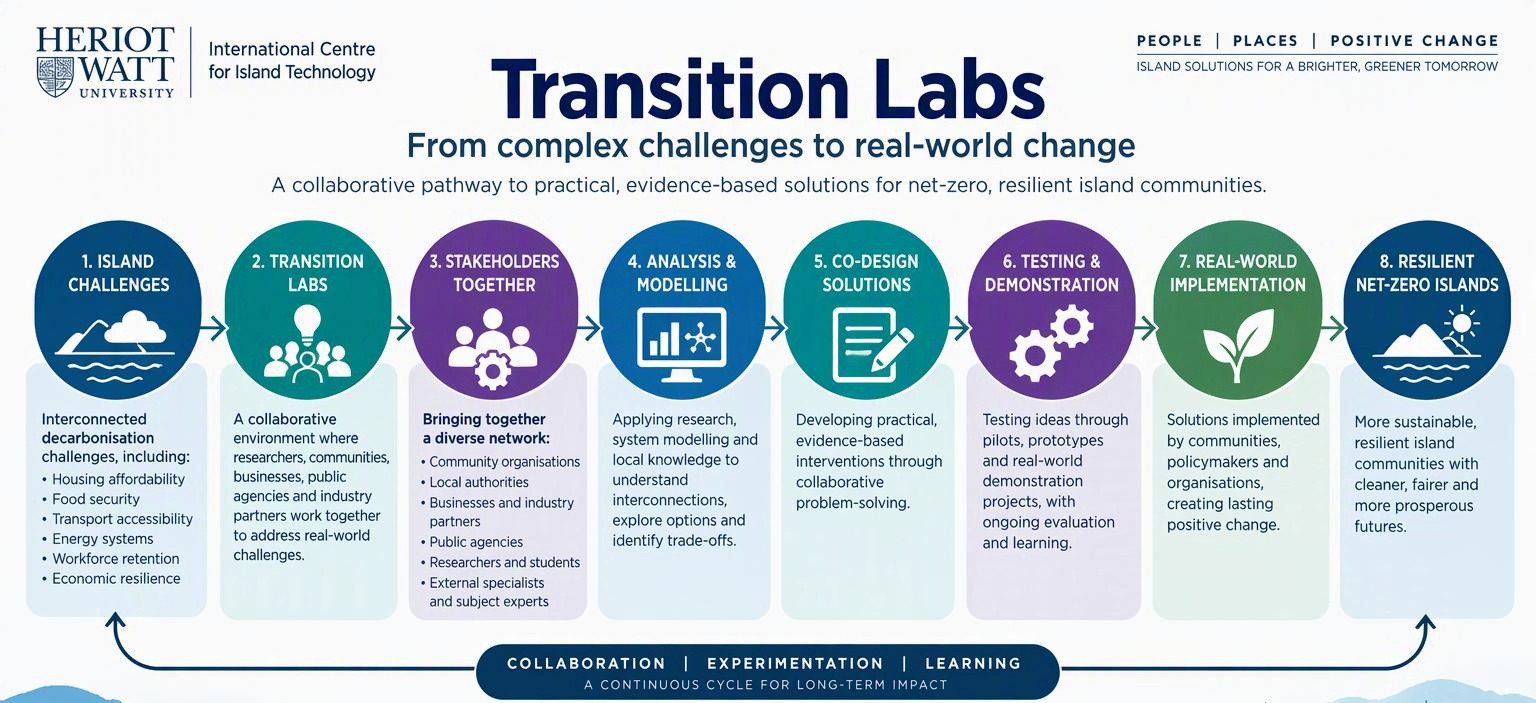
Island communities face interconnected decarbonisation challenges, from housing affordability and food security to transport accessibility, workforce retention, energy systems and economic resilience. These challenges rarely have simple answers: solving one can affect several others. Heriot-Watt University has established Transition Labs to address them as the research partner for the Islands Centre for Net Zero.
The Labs provide a collaborative environment where researchers, communities, businesses, public agencies and industry partners can work together to develop practical, evidence-based solutions to decarbonisation problems.
Through the Labs, participants identify real-world challenges, apply research, explore solutions and test ideas through modelling. This bridges the gap between knowledge and action, helping communities, policymakers and organisations develop interventions they can implement.
What are Transition labs?
Transition Labs are long-term collaborations that help stakeholders move from understanding a challenge to developing and testing practical responses. They provide a structured innovation process through user-centred research, system modelling, demonstration projects and collaborative problem-solving.
The Labs connect community organisations, local authorities, businesses and industry partners with researchers, students, external specialists and subject matter experts.
By combining local knowledge with academic expertise, the Labs ensure that research remains closely connected to the needs and priorities of island communities.
The overall aim is not simply to study problems, but to create pathways towards meaningful change through collaboration, experimentation and learning.
How the labs work
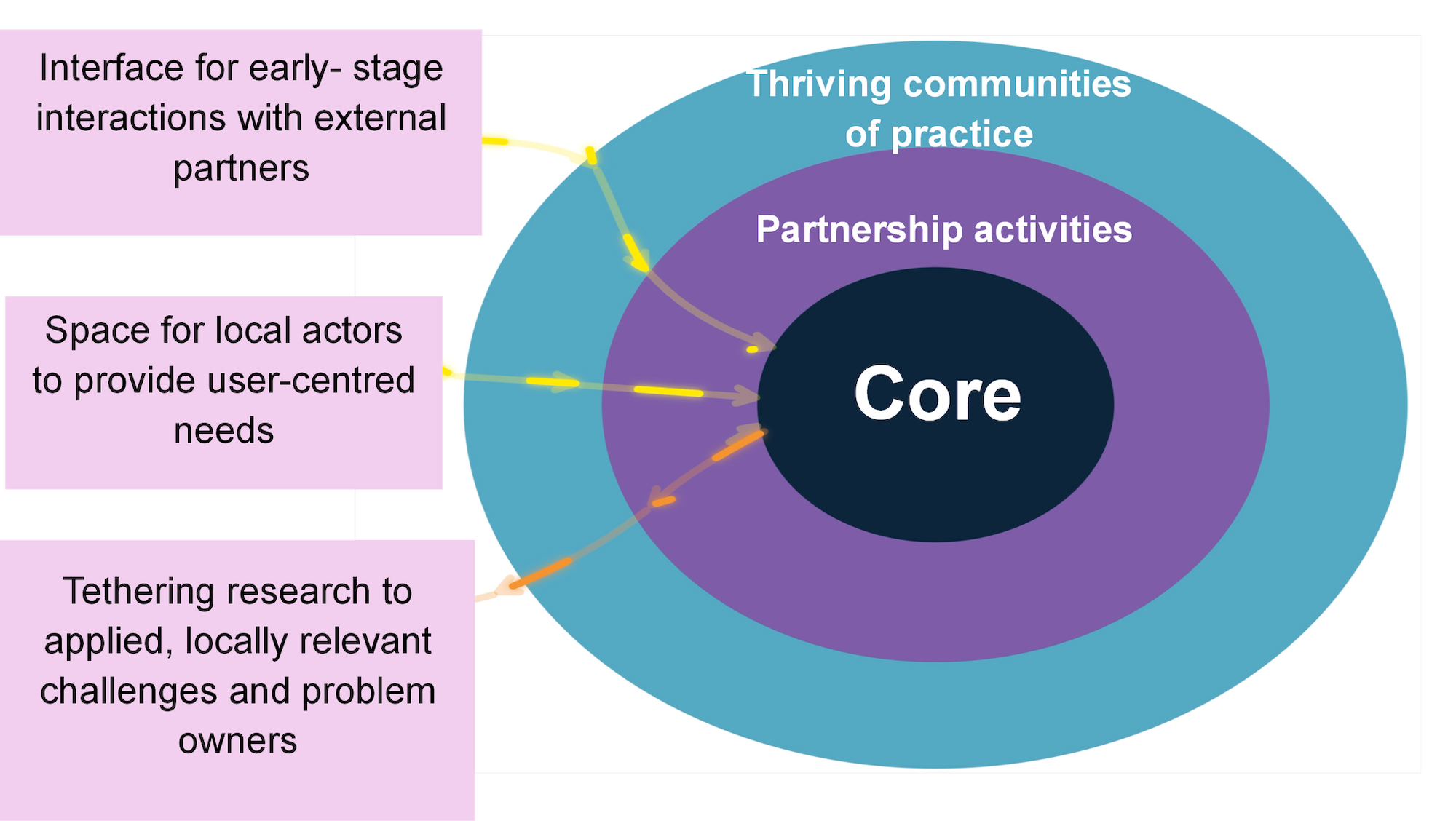
Each Transition Lab has three connected layers: an applied research core addressing real-world challenges; collaborative partnerships that co-design projects and share knowledge; and wider communities of practice that share learning and help successful approaches spread. Together, they support innovation and long-term collaboration.
Focus areas
Presently, Transition Labs are organised around three major portfolios that represent some of the most significant barriers and opportunities for island decarbonisation, resilience, and long-term prosperity.
Sustainable Food Security
This portfolio explores how island food systems can become more sustainable and secure. It addresses challenges in food production, supply chains, availability, affordability and resilience through improved production networks, shorter supply chains, increased local capacity and innovative approaches to food distribution.
Clean Transport and Mobility
This portfolio focuses on cleaner, more accessible and more efficient island mobility, connecting people to employment, education, healthcare and essential services while reducing carbon emissions. Areas of interest include electrification, transport integration, infrastructure planning and improving access.
Green Housing
This portfolio examines how sustainable housing systems can support healthy, resilient island communities. Access to affordable, energy-efficient homes is a pressing issue for many islands; areas of focus include affordability, availability, retrofit opportunities and building performance.
These themes have been selected because of their importance to community wellbeing, economic development, infrastructure decarbonisation, and the long-term sustainability of island populations.
Heriot-Watt University has developed skills and training programmes for partners and the wider community through a Centre of Excellence that supports the Transition Labs. The programmes build capability for sustainability transitions and evidence-based systems change across island communities, with the aim of supporting decarbonisation, generating economic opportunities, attracting external investment and leaving a lasting capability.
The Heriot-Watt Programme is led by Prof Aseem Kinra, Professor, Global Research Institute for Net Zero and Beyond.